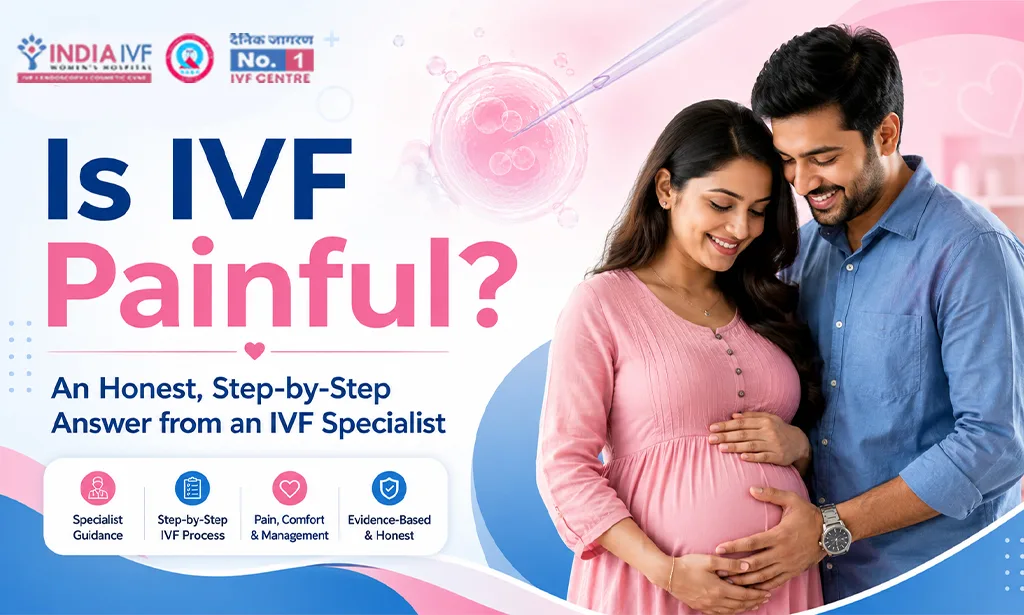
For most women, IVF is uncomfortable rather than painful. The injections feel like small pinpricks, egg retrieval is done under anaesthesia so you feel nothing during the procedure itself, and the embryo transfer feels like a slightly long Pap smear. The most common surprises are bloating during stimulation and period-like cramps afterwards — manageable, temporary, and far milder than the fear that keeps so many women waiting.
If you’ve been putting off IVF because you’re scared it will hurt, you’re in good company — “will it be painful?” is the first question half of our patients ask, often before they ask about success rates. So let’s go through the whole journey honestly, stage by stage, with real 0–10 pain scores — including one injection that genuinely can ache, which most “is IVF painful?” articles forget to mention.
Key Takeaways (the 60-second version)
- IVF is more uncomfortable than painful. Nothing in a standard cycle comes close to, say, childbirth.
- Egg retrieval — the step everyone dreads — is done under sedation. You feel nothing during it. Afterwards: period-like cramps for a day or two.
- The injections are tiny. Stimulation shots go just under the skin and feel like a pinch; most women self-inject by day three.
- The one that can actually ache is the progesterone-in-oil injection after transfer — and the good news is many protocols use a painless vaginal form instead.
- The hardest part isn’t physical — it’s the two-week wait. That’s emotional, and good support matters more than any painkiller.
- Severe pain is never normal in IVF. Sharp one-sided pain, heavy bleeding, vomiting or rapid bloating means call your clinic the same day.
The whole journey at a glance
| IVF step | Typical pain (0–10) | What it actually feels like |
| Daily stimulation injections | 2/10 | A mosquito-bite pinch, just under the skin |
| Monitoring scans | 1/10 | Brief pressure, like a routine internal scan |
| Trigger shot | 2/10 | Same as the daily jabs |
| Egg retrieval — during | 0/10 | Nothing — you’re under sedation |
| Egg retrieval — after | 3–4/10 | Period-like cramps and bloating for a day or two |
| Embryo transfer | 1/10 | Like a slightly long Pap smear |
| Progesterone support — vaginal | 0–1/10 | Painless (a pessary or gel) |
| Progesterone support — oil injection | 4–5/10 | The achy one — a deep muscle shot (often avoidable) |
| The two-week wait | Emotionally the hardest | No physical pain — pure nerves |
The stimulation injections (8–12 days) — pain score 2/10
Here’s the thing about IVF injections: the fear is almost always worse than the needle. Stimulation injections use very fine, short needles that go just under the skin of your belly — most women say it’s like a mosquito bite or a small pinch. The first one is scary; by day three, most of our patients are doing it themselves at home in under a minute.
Tips that genuinely help: ice the spot for ten seconds first, inject at the same time each day so it becomes routine, and rotate sides so no single spot gets sore. A little bruising or a small bump is normal, and it fades.
Monitoring scans — pain score 1/10
Every couple of days you’ll have a transvaginal ultrasound so we can watch your follicles grow. It’s the same scan you’ve likely already had during fertility testing — brief pressure, no pain, about two minutes. The blood draws alongside them are just standard needle pricks.
The trigger shot — pain score 2/10
This is the precisely-timed final injection that matures your eggs before retrieval. For most women it feels the same as the daily jabs. Some trigger medications are intramuscular and sting a little more — your nurse will show you exactly how to make it easy.
Egg retrieval — pain during: 0/10, after: 3–4/10
This is the step everyone fears, and the step where fear is least justified. You’re under short anaesthesia — deep (“twilight”) sedation — for about 20 minutes. You feel nothing, and there are no cuts and no stitches: the eggs are collected through a fine needle guided by ultrasound. Modern sedation (typically a combination like fentanyl and midazolam) is so effective that most women not only feel nothing during the procedure, they barely recall it.
Afterwards, expect period-like cramping and bloating for a day or two; most women are back to normal life within 48 hours with simple paracetamol. The honest caveat: if you produce a lot of eggs, the bloating can be more noticeable, and we’ll keep a close eye on you for that.
Embryo transfer — pain score 1/10
Five to ten minutes, no anaesthesia needed, a soft catheter passed gently through the cervix — it feels like a slightly long Pap smear with a full bladder. Many patients look up afterwards and say, “That’s it?” Yes. That’s it. You walk out and carry on with your day (gently).
Progesterone support — the injection most “is IVF painful?” pages forget
Here’s the honest bit almost no one tells you upfront. After your transfer, you’ll usually need progesterone for a couple of weeks to support the womb lining while you wait for the pregnancy test. And progesterone comes in two very different forms:
- Vaginal progesterone (a pessary or gel — names like micronised progesterone are common in India). Pain score: 0–1/10. Mildly messy, occasionally a little irritating, but essentially painless. Many of our protocols use exactly this.
- Intramuscular progesterone-in-oil (PIO). Pain score: 4–5/10 — the achiest part of IVF for the women who need it. It’s a thick oil, so it needs a bigger needle injected deeper into the muscle (usually the upper buttock), and the area can stay tender. Internationally, it’s widely described as the most uncomfortable IVF injection.
Why does this matter so much? Because most patients can avoid it. In a fresh transfer or a natural-cycle transfer, your body is already making its own progesterone, so the painless vaginal form is often all that’s needed. Intramuscular oil tends to be reserved for specific situations — and even then, there are real ways to take the sting out of it:
- Ice the spot before to numb it; warm the area afterwards with a heat pack to ease the ache and help the oil absorb.
- Warm the oil to body temperature in your hands first — cold oil hurts more.
- Rotate injection sites so no single spot gets overworked, and walk around a little afterwards.
If you’re someone for whom needles are a real fear, ask your specialist at the planning stage whether a vaginal-progesterone protocol suits you. The point of this section is simple: you deserve to know this before you start, not discover it on day two of the wait.
How IVF pain compares to things you already know
Pain scores on their own can feel abstract, so here’s IVF measured against everyday reference points:
- Versus a blood test: the daily injections are gentler — finer needles, just under the skin.
- Versus a Pap smear: the embryo transfer is roughly the same, maybe a touch longer.
- Versus period cramps: the after-effects of egg retrieval feel like a heavier-than-usual period for a day or two.
- Versus childbirth: not in the same universe. Nothing in a routine IVF cycle approaches the pain of labour. If you’ve delivered a baby before, IVF will genuinely surprise you with how mild it is.
The takeaway: IVF asks for patience and a little tolerance of discomfort — not bravery in the face of pain.
The two-week wait — the part that actually hurts
Let me be honest about the hardest part of IVF: it isn’t physical. The fourteen days between transfer and the pregnancy test are an emotional marathon — hope, fear, and symptom-googling at 2 a.m. (Is that twinge a good sign? A bad one? Usually it’s neither — mild cramping in this window is completely normal and doesn’t predict the result either way.)
We tell every couple the same thing: plan distractions, lean on each other, and call us instead of Google. Counselling is part of your treatment at India IVF Fertility, not an optional extra — because we know this wait, not the needles, is the real test.
Side effects & when to call us
During stimulation: bloating, mild mood swings, tender breasts, the occasional headache — your ovaries are doing a month’s work in ten days, so a feeling of fullness is expected. After retrieval: cramping and light spotting for a day or two.
But know this clearly: severe pain is NOT normal at any stage of IVF. Sharp one-sided pain, heavy bleeding, vomiting, breathlessness, or rapid abdominal swelling needs a same-day call to your clinic. These can be signs of ovarian hyperstimulation syndrome (OHSS) or another complication that we want to catch early. The reassuring part: with modern antagonist protocols and gentler trigger strategies, severe OHSS has become rare — under 1% in our practice.
How we keep IVF comfortable at India IVF Fertility
- Finest-gauge needles and self-injection training until you’re genuinely confident — never rushed.
- Anaesthesia for every egg retrieval. Never a “just bear with it” approach.
- Soft-catheter, ultrasound-guided transfers for a gentle, accurate placement.
- A progesterone plan chosen for comfort — including the vaginal route wherever it’s clinically suitable.
- WhatsApp access to your care team for every “is this normal?” moment.
- Honest counselling before you start, so nothing on this page surprises you on the day.
A word from Dr. Richika Sahay Shukla
“In twenty years, I’ve watched countless women walk in pale with fear of the needles and walk out saying, ‘I waited a year for this?’ The discomfort of IVF is real but small and brief — the thing that actually hurts my patients is the waiting, and the fear they carried alone before coming in. My promise is simple: I’ll tell you honestly what each step feels like, I’ll choose the gentlest option that’s right for you, and I’ll never ask you to ‘just tolerate’ pain we can prevent.”
— Dr. Richika Sahay Shukla, Founder & Director, India IVF Fertility
Trust & Transparency
This article is general education, not personal medical advice, and pain is genuinely individual — your experience may be milder or slightly more than the typical scores here. We’ve included the honest parts (yes, the oil injection can ache; yes, the wait is hard) precisely because being prepared is what makes IVF feel manageable. Your exact protocol — including the gentlest progesterone option for you — is decided with your specialist after a proper evaluation.
Don’t let fear of pain cost you another year
Fear of pain should never be the reason you wait. Come and meet us — see the clinic, ask every question, and decide with facts instead of fear. Book a free consultation at any India IVF Fertility centre — Delhi (Rohini / Basant Lok), Gurugram, Noida, Ghaziabad, Gwalior or Srinagar.
📞 Call +91-7353873538 or visit www.indiaivf.in.
Medically reviewed by
Dr. Richika Sahay Shukla — MBBS (Gold Medalist), DNB, MNAMS, MRCOG (London); Founder & Director, India IVF Fertility. IVF & infertility specialist trained at AIIMS and Sir Ganga Ram Hospital.
References & Authoritative Sources
- American Society for Reproductive Medicine (ASRM) — patient resources on IVF and what to expect. https://www.reproductivefacts.org/
- Mayo Clinic — In vitro fertilization (IVF): What you can expect. https://www.mayoclinic.org/tests-procedures/in-vitro-fertilization/about/pac-20384716
- Cleveland Clinic — IVF (In Vitro Fertilization): Procedure & How It Works. https://my.clevelandclinic.org/health/treatments/22457-ivf
- NHS (UK) — IVF: What happens. https://www.nhs.uk/conditions/ivf/what-happens/
- ESHRE — guidance on ovarian stimulation and luteal-phase (progesterone) support. https://www.eshre.eu/Guidelines-and-Legal
- ClinicalTrials.gov — Optimizing Patient Analgesic Experience During IVF (egg-retrieval sedation). https://clinicaltrials.gov/study/NCT01814657
- Indian Council of Medical Research (ICMR) / Government of India — The Assisted Reproductive Technology (Regulation) Act, 2021. https://www.indiacode.nic.in/handle/123456789/17046