
Stem Cell Therapy in IVF:
A New Frontier
Exploring what regenerative medicine might offer in fertility care for couples facing complex reproductive challenges.
Introduction
Stem cell therapy is one of the most talked-about frontiers in regenerative medicine, and researchers are now exploring what it might offer in fertility care. For couples facing infertility linked to poor ovarian reserve, low Anti-Müllerian Hormone (AMH), premature ovarian insufficiency (POI), a thin uterine lining, or repeated IVF disappointments, it has become a genuine source of hope — and a lot of honest questions.
Here's the simple difference. Most fertility treatments work by stimulating the ovaries or helping fertilization along. Stem cell therapy takes a different angle: it aims to support your body's own natural repair and renewal. Scientists are studying whether stem cells can help refresh the ovarian environment, improve the receptivity of the womb, and create healthier conditions before an IVF cycle.
Early studies in selected patients have shown encouraging signs — but we'll be honest with you: this is still an evolving treatment, and it isn't right for everyone. Any decision should follow a proper fertility evaluation by an experienced specialist. At India IVF, every patient gets a detailed assessment — age, ovarian reserve, hormone profile, medical history and past treatments — so your plan fits you, not a template.
What is Stem Cell Therapy?
Stem cell therapy is a regenerative treatment that uses special cells able to grow into different kinds of body tissue. These cells also release natural "helpers" — growth factors, cytokines and other bioactive molecules — that support the body in healing and repairing itself.
Unlike ordinary cells, which each do one fixed job, stem cells have two special talents: they can make more copies of themselves, and they can turn into specialised cells when the body signals them to. Those two abilities are why researchers study them across so many fields — orthopaedics, neurology, cardiology, wound healing, and now reproductive medicine.
One thing we want to be very clear about: in fertility care, stem cells are not used to "create eggs" or "guarantee pregnancy." Instead, they're being investigated for whether they can improve the health of ovarian tissue, boost blood supply, ease inflammation and support tissue renewal. The early research is promising, but larger, long-term studies are still needed before it becomes a routine treatment worldwide.
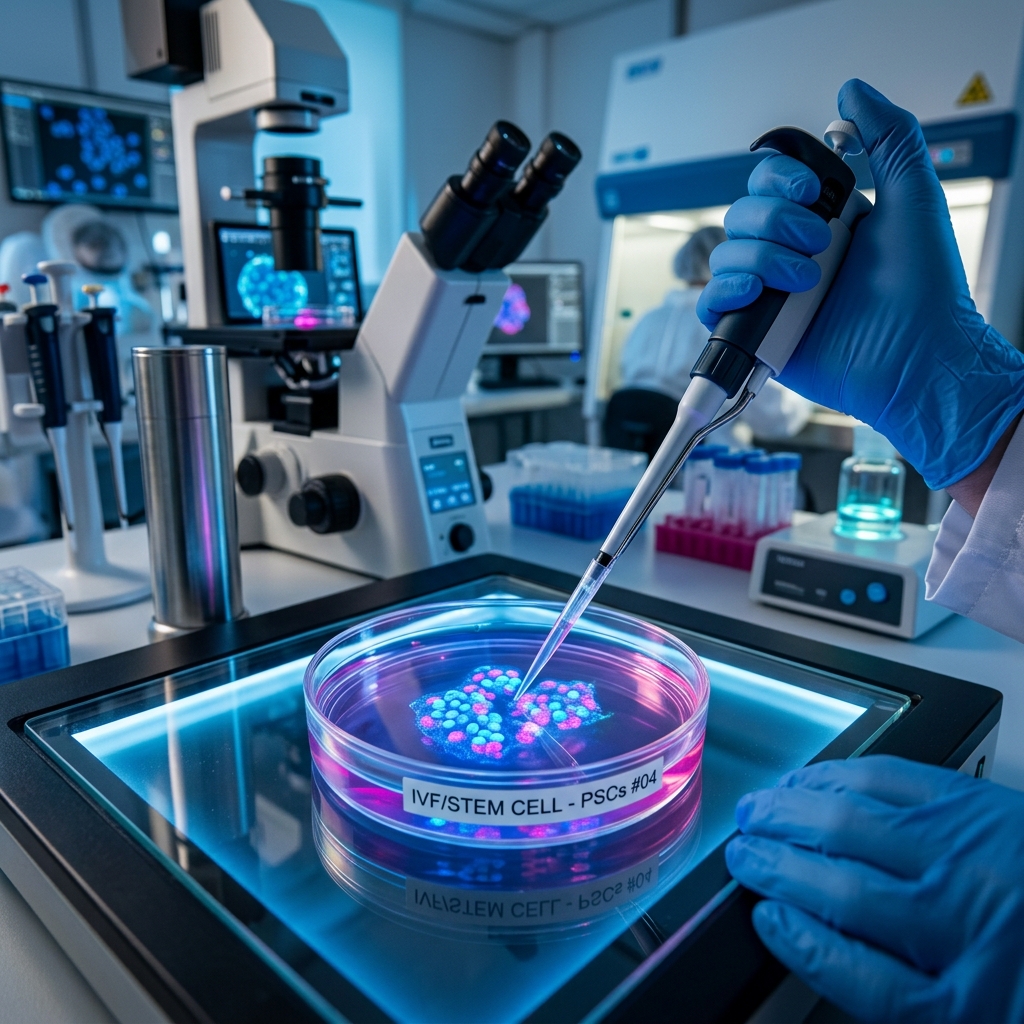
What is Stem Cell Therapy in IVF?
Stem cell therapy in IVF simply means using regenerative stem cells before or alongside your IVF treatment, with the goal of improving the reproductive environment first.
It doesn't replace IVF. Think of it as a possible supporting act — an adjunct that may be considered in specific situations where conventional treatment alone hasn't given the results a couple hoped for. Depending on your condition, stem cells are being studied to help:
- Support ovarian rejuvenation
- Improve blood flow to the ovaries
- Encourage a healthier, thicker endometrium (womb lining)
- Improve the womb's readiness for an embryo
- Promote tissue repair
- Calm chronic inflammation that can affect fertility
The main aim is to prepare your ovaries or womb so they respond better during IVF. Importantly, stem cell therapy doesn't replace egg retrieval, embryo culture, fertilization, or embryo transfer — IVF stays the main treatment.
Why is Stem Cell Therapy Needed?
Not every couple needs stem cell therapy — most conceive with conventional care like ovulation induction, IUI or IVF. But some people have deeper reproductive challenges where the ovaries or womb keep responding poorly despite several honest attempts. In those situations, regenerative therapies are being studied as an extra option worth understanding.
Low AMH
A low AMH usually points to a reduced egg supply. Stem cell therapy can't create new eggs — but researchers are studying whether it might improve the ovarian environment and support the follicles you do have before IVF.
Poor Ovarian Reserve
Poor ovarian reserve means fewer eggs remain than expected for your age, which often means fewer eggs collected during IVF. Scientists are studying whether stem cell therapy can improve ovarian function in selected patients.
Premature Ovarian Insufficiency
POI is when ovarian function declines before age 40. Conventional options are limited here, which is exactly why regenerative research into ovarian rejuvenation has opened hopeful new avenues for carefully chosen cases.
Thin Endometrium
A healthy womb lining is essential for an embryo to implant. Researchers are studying whether stem cells can help the lining regenerate, build new blood vessels and repair itself for women whose lining stays too thin.
Recurrent Implantation Failure
Sometimes good embryos are transferred again and again, and still don't implant. Stem cell therapy is being investigated as one possible way to improve womb receptivity in selected patients after careful evaluation.
Repeated IVF Failure
When several IVF cycles haven't worked, it deserves a proper investigation. Specialists may suggest advanced tests or supportive therapies — including regenerative approaches still being studied through research.
Male Infertility
Stem cell therapy is also being explored in male infertility research, especially where there's severe testicular damage or very low sperm production. For now these uses remain largely investigational, and proven treatments like ICSI or surgical sperm retrieval stay the main options for most men.
Types of Stem Cell Therapy Used in Fertility
Different kinds of stem cells are being studied in reproductive medicine. The right choice depends on your condition, the clinical protocol and the current evidence.
Bone Marrow-Derived Stem Cells (BMSCs)
Among the most studied cells in regenerative medicine. They're collected from the patient's own bone marrow, processed in a specialised lab, and researched for their possible role in ovarian or endometrial renewal.
Adipose-Derived Stem Cells (ADSCs)
Gathered from body fat through a minimally invasive procedure, these cells are rich in regenerative growth factors and are being evaluated in research for tissue repair and better blood supply — with some studies showing improved womb-lining thickness in selected patients.
Umbilical Cord-Derived Mesenchymal Stem Cells (UC-MSCs)
Collected from donated umbilical cord tissue under regulated conditions, these cells have drawn attention for their regenerative properties and are being studied across several areas of medicine, including reproductive health.
Menstrual Blood-Derived Stem Cells
Menstrual blood contains stem-cell-like cells that researchers are exploring for regenerative uses. Their role in fertility remains experimental, and more evidence is needed before wider use.
Which Type is Best?
Honestly, there's no single "best" type yet. The choice depends on the cause of infertility, your age, ovarian reserve, womb health, past IVF history, the current evidence, and your specialist's judgement. A personalised assessment always comes first — there are no shortcuts here.
Procedure of Stem Cell Therapy in IVF
Stem cell therapy for fertility is a carefully planned process, done only after a detailed evaluation. It's not a replacement for IVF, but a possible supportive step before it, for selected patients.
Initial Consultation & Assessment
It starts with a proper sit-down with your fertility specialist to review your history, past treatments, age and overall health. Common tests help decide whether the therapy is appropriate.
Patient Selection
Not everyone is a suitable candidate. Your specialist weighs your age, ovarian reserve, hormone profile, and womb condition. Only carefully selected patients may benefit.
Stem Cell Collection
Depending on the plan, cells may come from bone marrow, fat (adipose) tissue, or umbilical-cord-derived sources using minimally invasive techniques under sterile conditions.
Laboratory Processing
The sample goes to a specialised lab, where the team isolates the needed stem cells under strict quality control and prepares them for use following approved protocols.
Stem Cell Administration
Depending on your needs, the specialist may direct the cells to support the ovarian tissue or the uterine cavity. Done only by experienced professionals.
Recovery and Follow-up
Most patients head home the same day. Follow-up includes ultrasound monitoring and hormone tests to see how you're progressing before planning IVF.
IVF Treatment
If the reproductive environment looks ready, you move on to your planned IVF cycle. Stem cell therapy is there to complement these proven steps, never to replace them.
How Stem Cells May Improve Fertility
Researchers believe stem cells support fertility mainly through regeneration — improving the environment — rather than by making new eggs or embryos.
Supporting Ovarian Regeneration
Releasing growth factors that may enhance ovarian function in women with diminished reserve.
Improving Blood Supply
Encouraging the growth of new blood vessels, improving oxygen delivery to reproductive tissues.
Reducing Inflammation
Anti-inflammatory properties that may help create a healthier reproductive environment.
Improving Endometrial Receptivity
Helping improve endometrial thickness and receptivity in carefully selected patients.
Benefits of Stem Cell Therapy in IVF
Research is ongoing, but several possible benefits have been reported in selected patients:
-
Improved ovarian function Regenerative therapy may support ovarian tissue health and responsiveness before IVF.
-
Better endometrial thickness Women with a persistently thin lining may see improvement, though results vary.
-
Personalised fertility care The approach is tailored to your condition, not a one-size-fits-all protocol.
-
Potential improvement in IVF readiness By supporting ovarian or womb health in selected patients. Pregnancy can't be guaranteed.
Success Rate of Stem Cell Therapy in IVF
The honest answer is — there's no single number that fits everyone. Outcomes depend on your age, the cause of infertility, ovarian reserve, AMH, womb condition, the type of therapy, your IVF history and your overall health.
To give you a real-world example: in a 2025 study from Spain, a stem-cell-based ovarian treatment produced signs of ovarian activation in around 70% of women with ovarian failure, with roughly 7% conceiving naturally and 14% through IVF, and no serious side effects — but the researchers were clear that larger studies are still needed to confirm this.
Please be cautious of any clinic advertising "guaranteed pregnancy" or fixed success percentages. A fertility specialist can give you a realistic, personalised picture based on your own situation.
Risks and Safety
Is Stem Cell Therapy Safe?
When done under proper medical supervision using regulated clinical protocols, stem cell therapy is generally considered safe. Because many fertility uses are still investigational, it should only be undertaken at experienced centres.
Possible Risks
Though uncommon, possible risks include mild pain or discomfort at the collection site, temporary bleeding or bruising, rare infection, and — importantly — no improvement in some patients.
Current Limitations
It doesn't cure every cause of infertility. It can't reverse the natural, age-related decline in egg quality. It doesn't guarantee pregnancy or a live birth. You may still need IVF or ICSI. For all these reasons, it's best seen as one part of a complete fertility plan — never a standalone miracle.
Stem Cell Therapy Cost in India
The cost of stem cell therapy for infertility in India can vary quite a bit, depending on the type of cells used, the lab processing, the treatment protocol, and whether it's combined with an IVF cycle. Because it's so personalised, there's no fixed price that fits every patient. During your consultation, your specialist will explain the most appropriate plan and provide an estimated cost. At India IVF, we believe in transparent pricing.
Why Choose India IVF?
Experienced Specialists
Our team of fertility consultants reviews every case individually before recommending advanced treatments.
Personalized Plans
Your plan is built around your age, AMH, history, and goals. No two journeys are the same.
Advanced IVF Lab
Precision matters. Our advanced embryology lab follows strict quality-control protocols.
Comprehensive Services
Everything under one roof — IVF, ICSI, IUI, egg freezing, so your care stays joined-up.
Patient-Centric Care
Our team offers compassionate guidance, clear communication and steady support.
Ethical Practice
Recommendations based on current medical evidence. Trust is built on truth.

Questions About Stem Cell Therapy in IVF
Understanding your options is an important step toward confidence and clarity. Below are some of the most common questions patients ask when considering stem cell therapy - answered with honesty, medical transparency, and compassion.