I know exactly what is going through your mind right now. You’ve just finished your transfer, you’re looking at that tiny spot on the ultrasound screen, and your heart is full of hope. But then, the anxiety kicks in. You wonder, “Should I even move? Should I stay in bed for 15 days? What if the embryo falls out?” Beta, let me tell you, bed rest after embryo transfer is one of the biggest points of confusion for every couple we meet. In this blog, I want to talk to you heart-to-heart, just like I do with my patients in the clinic, to explain what is a myth and what is the actual reality.
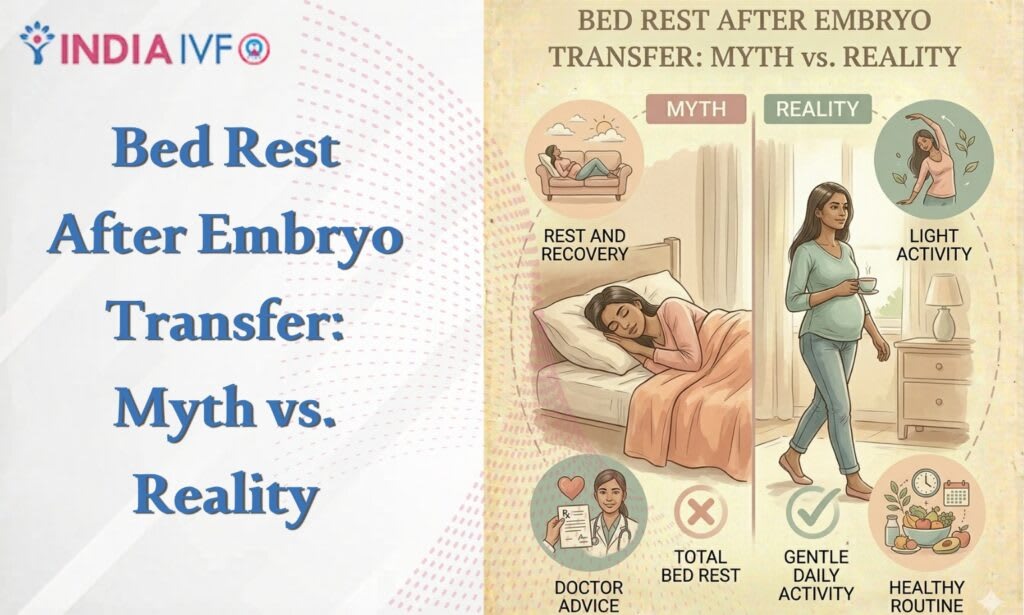
India IVF Clinic wants you to breathe a sigh of relief first. Many patients think that the moment they stand up after the procedure, gravity will work against them. But listen to me carefully: the bed rest after embryo transfer that your grandmother or some old internet forums suggest is actually not required by modern science. Your uterus is not a hollow jar; it’s a beautiful, muscular organ where the walls stay touching each other. Think of the embryo like a tiny seed placed inside a peanut butter sandwich. No matter how much you turn that sandwich, the seed isn’t going anywhere! At our clinic, we focus on making sure you are relaxed, not restricted.
Why Science Says “No” to Strict Bed Rest
India IVF Clinic has seen thousands of success stories, and I can tell you that staying glued to your bed doesn’t increase your chances of a positive pregnancy test. In fact, when I tell my patients at the Best IVF Centre in Delhi that they can walk out of the procedure room comfortably, they are often shocked. But why was bed rest ever a thing? Years ago, doctors were extra cautious because they didn’t have the data we have today. Now, multiple international studies have proven that patients who move around normally have the same—if not better—success rates than those who stay in bed.
India IVF Clinic specialists often explain that when you lie down for days, your blood circulation actually slows down. For a successful pregnancy, your uterus needs a very good supply of fresh, oxygenated blood. If you are just lying there, worrying and staring at the ceiling, your stress levels (cortisol) go up, and your blood flow isn’t as active as it should be. This is one of those IVF myths that we are working hard to break at the Best IVF centre in Noida. We want you to be happy, mobile, and positive, not treated like a patient who is “ill.”
Can I Walk? Can I Work? Your Activity Level After Transfer
India IVF Clinic gets this question every single day: “Can I walk after IVF?” My answer is always a big, smiling “Yes!” Walking is actually your friend. I usually suggest my patients take a light stroll, go to the kitchen to make a cup of tea, or even go for a movie if they feel like it. Now, I’m not saying you should go and join a marathon or start lifting heavy buckets of water. But normal, day-to-day activity level after transfer is perfectly healthy. It keeps your mind busy and your body active.
India IVF Clinic advises that the “Two-Week Wait” is a mental game. If you sit at home doing nothing, you will Google every minor cramp and every tiny sensation in your body. That leads to “Google-itis”—a very common condition where patients scare themselves for no reason! Whether you are visiting us in Delhi or Noida, we tell you that light activity is the best medicine for your mental health. If you have a desk job, you can even go back to work after a day or two of rest. Just keep things “halka-fulka” (light) and don’t take too much stress.
The Reality of Implantation: How It Actually Works
Many of my patients worry that the embryo is “loose” inside. Let me explain it simply. The embryo transfer is like placing a tiny pearl into a very soft, velvety cushion that is coated with a natural “glue.” Within 24 to 48 hours, the embryo starts the process of “hatching” and sticking to the uterine lining. This is a chemical process. It’s about hormones and receptors, not about whether you sat up or laid down.
Common IVF Myths We Hear in India
- “Doctor, can I use the Indian toilet?”
- Beta, don’t worry. Using any toilet—Indian or Western—does not put pressure on the embryo. It is perfectly safe.
- “Should I avoid climbing stairs?”
- In many Indian homes, we have to climb stairs. Doing it once or twice a day slowly is fine. You don’t need to shift to the ground floor!
- “Can I travel in an auto-rickshaw?”
- While I suggest avoiding very bumpy roads, a normal commute in a car or a smooth rickshaw ride is not going to cause a failure.
- “Do I have to sleep on my back only?”
- Not at all. You can sleep on your side, your stomach, or your back. The embryo is safe inside the muscular walls of the uterus.
What Should You Actually Avoid? (The Risks)
While I am telling you to be active, there are a few “Caution” signs. I want you to avoid:
- Heavy Lifting: No shifting furniture or carrying heavy grocery bags.
- Vigorous Exercise: No gym, no heavy jogging, and no Zumba for these two weeks.
- Extreme Heat: Avoid very hot baths, saunas, or keeping a heating pad directly on your tummy. We want to keep your core body temperature stable.
- Intercourse: It’s better to avoid this as it can cause uterine contractions which we want to prevent during the implantation phase.
Risk and Utility Analysis of Bed Rest
| Factor | Strict Bed Rest (The Myth) | Normal Activity (The Reality) |
| Risk of Blood Clots | High (DVT risk increases) | Low (Movement keeps blood flowing) |
| Stress/Anxiety | Very High (Too much thinking) | Lower (Mind stays occupied) |
| Uterine Blood Flow | Reduced | Improved |
| Utility for Implantation | Zero proven benefit | Helpful for physical & mental health |
Why Choose India IVF Clinic for Your Journey?
We don’t just give you medicines; we give you the right guidance. Our centres are equipped with the latest technology, but our heart is in traditional Indian care and empathy.
- Best IVF Centre in Delhi: Located in the heart of the city with world-class labs.
- Best IVF Centre in Noida: State-of-the-art facilities with a very high success rate.
- Transparent Care: No hidden myths, just honest science explained in your language.
Estimated Cost Table (IVF & Transfer in India)
Note: Costs are indicative and vary based on individual medical needs.
| Procedure Component | Estimated Cost (INR) | Remarks |
| IVF Cycle (Stimulation + Retrieval) | ₹1,25,000 – ₹2,20,000 | Includes monitoring & scans |
| Frozen Embryo Transfer (FET) | ₹35,000 – ₹55,000 | Includes lab prep |
| Post-Transfer Meds (Progesterone) | ₹15,000 – ₹25,000 | For the first 15 days |
| Consultation & Counselling | ₹1,000 – ₹2,000 | Per session |
Important Tips for the “Two-Week Wait”
- Eat “Ghar ka Khana”: Freshly cooked, simple Indian meals are best. Include lots of green veggies and fruits.
- Stay Hydrated: Drink at least 2-3 liters of water. Coconut water is also great.
- Medication is King: The only thing you must be strict about is your medicines. Set alarms for your progesterone and estrogen doses.
- Watch Funny Movies: Laughter reduces stress. Stay away from “Rona-Dhona” (sad) serials for a while!
- Talk to Us: If you feel spotting or a sharp pain, don’t panic. Just call your coordinator at India IVF Clinic.
Conclusion:
The wait after embryo transfer is a time of “active waiting.” You are not a patient in bed; you are a mother-to-be who is taking care of herself. Trust the science, trust the Best IVF Centre in Delhi, and most importantly, trust your own body. You’ve done the hard work, now let nature take its course.
Confused about your IVF journey? Don’t let myths hold you back. Come speak to our experts at India IVF Clinic. Whether you are looking for the best care in Delhi or Noida, we are here to guide you every step of the way.
Book Your Consultation with Our Doctors Today!- Book Now
Reference:
ESHRE – European Society of Human Reproduction and Embryology: https://www.eshre.eu/