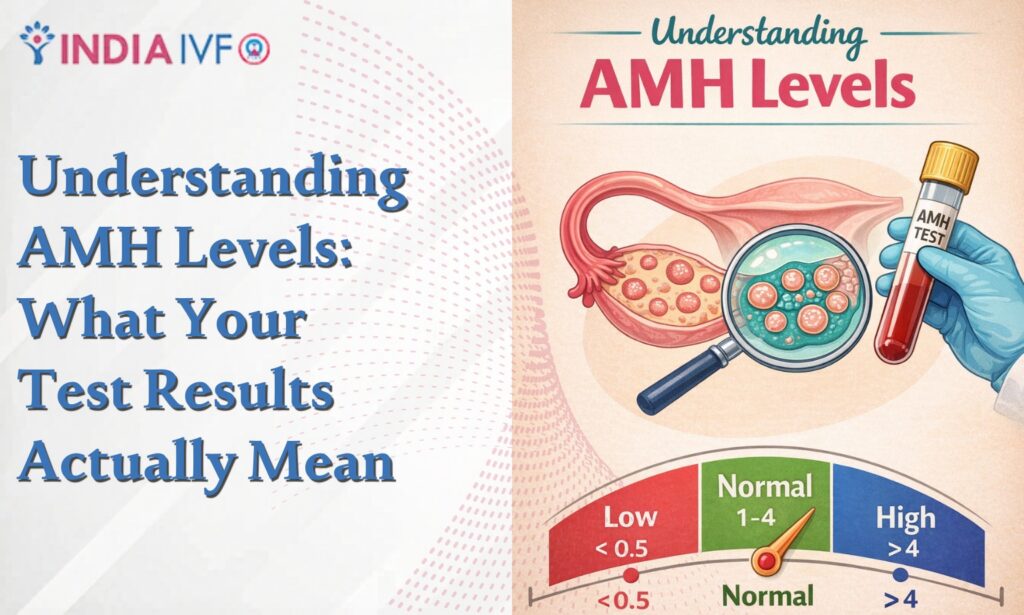
In the modern era of reproductive health, “knowledge is power.” Whether you are planning to start a family soon, considering freezing your eggs, or simply curious about your biological clock, you have likely come across the term Anti-Mullerian Hormone (AMH Levels). Often referred to as the “fertility thermometer,” AMH has become a cornerstone of the modern fertility blood test. However, receiving your lab report can be an overwhelming experience. Numbers like “0.5 ng/mL” or “4.2 ng/mL” don’t mean much without context. Does a low number mean you can never conceive? Does a high number mean you are super-fertile? In this guide, we will break down everything you need to know about AMH ranges, how they change with age, and what your results truly mean for your reproductive future.
What Exactly is Anti-Mullerian Hormone (AMH)?
Anti-Mullerian Hormone (AMH Levels) is a glycoprotein hormone produced by the granulosa cells in the small, early-stage follicles of a woman’s ovaries. These follicles are the “sacs” that contain immature eggs.
Unlike other hormones like FSH (Follicle Stimulating Hormone), which fluctuate wildly during your menstrual cycle, AMH remains relatively stable. This makes it an excellent marker for a fertility blood test because it can be drawn at any time of the month.
The Concept of Ovarian Reserve
To understand AMH Levels, you must understand the “Ovarian Reserve.” A woman is born with all the eggs she will ever have (roughly 1–2 million). By puberty, this number drops to about 300,000–400,000. Throughout her reproductive years, she loses eggs every month. AMH levels act as a proxy to tell us how many eggs are left in the “vault.”
Important Note: AMH tells us about quantity, not necessarily quality.
The Utility and Risks of AMH Testing: A Detailed Analysis
When we discuss the utility and risks of a fertility test, we look at how the data helps medical decisions versus the potential downsides of relying solely on one metric.
Clinical Utility (The Benefits)
-
IVF Protocol Design: The most significant utility of AMH is in Assisted Reproductive Technology (ART). Doctors use your AMH level to determine the dose of stimulation drugs. A high AMH requires lower doses to prevent complications, while a low AMH may require “mini-IVF” or aggressive stimulation.
-
Predicting Menopause: While not 100% predictive, a declining trend in AMH can help women understand if they are likely to experience premature menopause.
-
Identifying PCOS: High AMH levels (typically above 5.0 ng/mL) act as a diagnostic utility for Polycystic Ovary Syndrome, where the ovaries contain an abnormally high number of small follicles that don’t release eggs.
-
Monitoring Ovarian Health: For women undergoing cancer treatments or surgeries for endometriosis, AMH utility lies in monitoring the damage or recovery of the ovarian tissue.
Clinical and Psychological Risks (The Limitations)
-
The Stress Risk: Perhaps the greatest risk of AMH testing is the psychological impact of a “low” result. Many women equate low AMH with absolute infertility, leading to unnecessary anxiety. In reality, you only need one healthy egg to conceive naturally.
-
The “False Security” Risk: A high AMH can give women a false sense of security, leading them to delay pregnancy. However, AMH does not track egg quality (chromosomal health), which declines sharply after age 35 regardless of the AMH level.
-
Fluctuation Risks: While generally stable, certain factors like Vitamin D deficiency or long-term use of oral contraceptives can suppress AMH levels, leading to a “false low” reading that might trigger invasive and expensive treatments prematurely.
Decoding the Numbers: Understanding AMH Ranges
When you receive your results, the value is usually measured in nanograms per milliliter (ng/mL). While every laboratory has slightly different reference scales, the following AMH Levels ranges are generally accepted by fertility specialists:
High: Above 3.5 ng/mL
While a high reserve sounds positive, excessively high levels (above 4.0 or 5.0 ng/mL) are often a clinical indicator of PCOS (Polycystic Ovary Syndrome). In PCOS, the ovaries have many small follicles, but they fail to mature and release an egg (ovulation), leading to high AMH but difficulty conceiving.
Optimal: 2.0 ng/mL to 3.5 ng/mL
This range is considered ideal for fertility. It suggests a healthy ovarian reserve and typically correlates with a good response to fertility treatments like IVF.
Low-Normal: 1.0 ng/mL to 2.0 ng/mL
In this range, the ovarian reserve is beginning to diminish. While conception is still very much possible naturally, it serves as a signal to not delay family planning for too many years.
Low: 0.5 ng/mL to 1.0 ng/mL
This indicates a “diminished ovarian reserve” (DOR). If your levels are in this range, it suggests that the number of eggs is significantly lower than average for a woman of reproductive age.
Very Low: Below 0.5 ng/mL
Levels in this range suggest a severely depleted egg count. Women in this category may struggle to produce enough eggs during an IVF cycle and might need more aggressive protocols or donor eggs.
AMH Levels by Age: The Biological Reality
One of the most frequent mistakes women make is comparing their AMH levels to a friend’s without considering age. AMH levels by age are the most critical context for your results. A level of 1.0 ng/mL is considered “low” for a 25-year-old but is considered “completely normal” for a 42-year-old.
As a rule of thumb, AMH peaks in your early 20s and begins a steady decline after age 25, with a sharper drop-off after age 35.
| Age | Estimated Average AMH Level (ng/mL) |
| 20 – 24 | 4.0 – 5.0 |
| 25 – 29 | 3.0 – 4.5 |
| 30 – 34 | 2.5 – 3.5 |
| 35 – 37 | 1.0 – 2.0 |
| 38 – 40 | 0.5 – 1.2 |
| 41 – 45 | 0.2 – 0.5 |
| Over 45 | < 0.2 (Undetectable) |
Why Age Matters More Than the Number
Age is the primary determinant of egg quality. A 28-year-old with a low AMH of 0.7 ng/mL often has a better chance of getting pregnant than a 40-year-old with a “normal” AMH of 1.2 ng/mL. This is because the 28-year-old’s few remaining eggs are likely genetically healthy, whereas the 40-year-old’s eggs are more prone to chromosomal abnormalities.
Identifying the Red Flags: Low AMH Symptoms
One of the trickiest aspects of ovarian reserve is that it doesn’t always present obvious physical signs. However, there are some low AMH symptoms and indicators that might suggest it’s time to get tested:
- Shortened Menstrual Cycles: If your cycle has historically been 30 days and is now consistently 24 or 25 days, it could mean your body is “rushing” the ovulation process because the egg supply is low.
- Irregular or Missed Periods: While this can be caused by many factors, it is a primary symptom of a declining ovarian reserve.
- Heavier or Much Lighter Flow: Changes in the character of your period can reflect hormonal shifts associated with low AMH.
- Difficulty Conceiving: If you are under 35 and have been trying for a year, or over 35 and trying for 6 months without success, low AMH might be a factor.
- History of Autoimmune Issues: Conditions like Hashimoto’s or Lupus can sometimes affect ovarian health.
What Causes Low AMH?
If your fertility blood test shows low levels, you might wonder why. It isn’t always just about age. Several factors can influence your ovarian reserve:
- Genetics: Some women are simply born with a smaller pool of eggs. If your mother went through early menopause, you might also have a lower AMH.
- Endometriosis: This condition can cause chocolate cysts (endometriomas) on the ovaries, which damage healthy ovarian tissue.
- Ovarian Surgery: Procedures to remove cysts can accidentally remove or damage healthy follicles.
- Environmental Factors: Smoking is the most significant lifestyle factor known to accelerate egg loss.
- Medical Treatments: Chemotherapy or radiation therapy can drastically lower AMH levels, often leading to premature ovarian failure.
The “High AMH” Paradox: Is More Always Better?
We often assume higher is better, but in the world of AMH, very high levels are a red flag for PCOS.
In a typical ovary, a few follicles start growing, and one becomes dominant and releases an egg. In a PCOS ovary, dozens of follicles start growing but “get stuck” in the early stages. Because AMH is produced by these early-stage follicles, having 30-40 of them leads to a very high AMH reading.
The irony of PCOS is that while you have “plenty of eggs,” you may not be ovulating at all, making natural conception difficult.
Why the AMH Test is the Gold Standard for Fertility
In the past, doctors relied solely on FSH (Follicle Stimulating Hormone). However, FSH must be tested on Day 2 or 3 of your period and can change from one month to the next.
The AMH fertility blood test is superior because:
- Consistency: It provides a stable reading throughout the month.
- Predictability: It is the best predictor of how a woman will respond to IVF medication.
- Early Detection: AMH usually starts to drop years before FSH starts to rise, giving women an “early warning system.”
Can You Increase Your AMH Levels?
This is the million-dollar question. Scientifically, you cannot “grow” new eggs. However, you can improve the environment in which those eggs mature and, in some cases, see a slight rebound in AMH levels by addressing underlying deficiencies.
1. Vitamin D Supplementation
Studies have shown that AMH levels can fluctuate seasonally because Vitamin D is involved in the expression of the AMH gene. If you are deficient, your AMH might appear lower than it actually is.
2. CoQ10 (Ubiquinol)
While CoQ10 doesn’t increase the number of eggs (AMH), it improves the “battery” of the egg (mitochondria), which helps with fertilization and embryo development.
3. DHEA
Under strict medical supervision, some fertility specialists prescribe DHEA to women with low AMH. It is an androgen that can sometimes “jump-start” the ovaries to produce better results during IVF.
4. Diet and Lifestyle
A Mediterranean diet rich in antioxidants (berries, leafy greens, wild-caught fish) helps reduce oxidative stress in the ovaries, protecting the remaining follicles.
Read More: Low AMH Levels: Causes, Symptoms, and Treatment Options for Better Fertility
Low AMH vs. Infertility: Clearing the Confusion
A low AMH result is not a diagnosis of infertility.
Think of AMH as the amount of fuel in a car’s gas tank. A low AMH means your tank is near empty, so you won’t be able to drive for much longer (you have fewer years of fertility left). However, as long as there is fuel in the tank, the car can still drive (you can still get pregnant). Many women with very low AMH levels conceive naturally every day. Why? Because natural conception only requires one good egg. IVF, on the other hand, is a numbers game where doctors want 10-15 eggs; this is where low AMH becomes a significant hurdle.
Cost and Table Analysis of Fertility Testing
Planning for a fertility blood test often involves budgeting. Below is an updated cost breakdown of AMH testing across various regions to help you prepare financially.
| Region | Average Cost (INR) | Included Services |
| India | ₹2,100 – ₹3,700 | Blood draw + Digital Report |
| USA | ₹11,300 – ₹23,500 | Lab fees (Insurance varies) |
| UK | ₹9,500 – ₹17,900 | Private Clinic Consultation |
| Australia | ₹7,500 – ₹13,200 | Specialist referral required |
Next Steps: What to Do After Your Results
If you’ve recently received your AMH ranges and are concerned, here is a step-by-step action plan:
Step 1: Consult a Fertility Specialist
General OB/GYNs are great, but an infertility specialist is better equipped to interpret these results in the context of your overall health.
Step 2: Get an Antral Follicle Count (AFC)
An AMH test should always be paired with an ultrasound. A doctor will count the visible follicles on your ovaries. If your AMH is low but your AFC is high, your situation might be better than the blood test suggests.
Step 3: Evaluate Your Timeline
- If you are young and want kids later: Consider egg freezing to lock in the current quality of your eggs.
- If you are currently trying: Don’t wait. Seek help sooner rather than later to maximize your window of opportunity.
- If AMH is near zero: Discuss options like Donor Eggs or Embryo Adoption, which have very high success rates regardless of your own AMH levels.
Conclusion: Your AMH is a Snapshot, Not Your Destiny
Understanding your AMH levels is a vital part of proactive healthcare. It allows you to make informed decisions about your career, relationships, and family planning. While a low result can be scary, remember that AMH ranges are just one piece of the puzzle. They measure quantity, not the miracle of quality. Whether your levels are optimal, low, or high, there is always a path forward—be it through lifestyle changes, timed intercourse, or advanced reproductive technology like IVF.
👉 Book a Consultation with our Fertility Experts Today and get a personalized roadmap for your parenthood journey.