A comprehensive guide to understanding the complexities of early ovulation and its influence on fertility, brought to you by the fertility experts at India IVF Fertility, the leading IVF and fertility clinic in Delhi, Noida, and Gurgaon.
Introduction
When you decide to grow your family, your menstrual cycle suddenly becomes a map you study every day. You start learning about the “fertile window,” the “luteal phase,” and the “two-week wait.” However, for many women, the map doesn’t always lead where they expect. One of the most confusing detours is early ovulation.
Early ovulation is a common concern that many women face, often without even realizing it. At India IVF Fertility, we believe that knowledge is the first step toward successful parenthood. In this comprehensive guide, we will explore everything you need to know about early ovulation, its impact on your pregnancy chances, and how you can manage it to achieve your dream of having a baby.
Early Ovulation: An Overview
To understand early ovulation, we first need to look at a “typical” cycle. Most medical textbooks describe a 28-day cycle where ovulation happens on Day 14. However, bodies are not clocks.
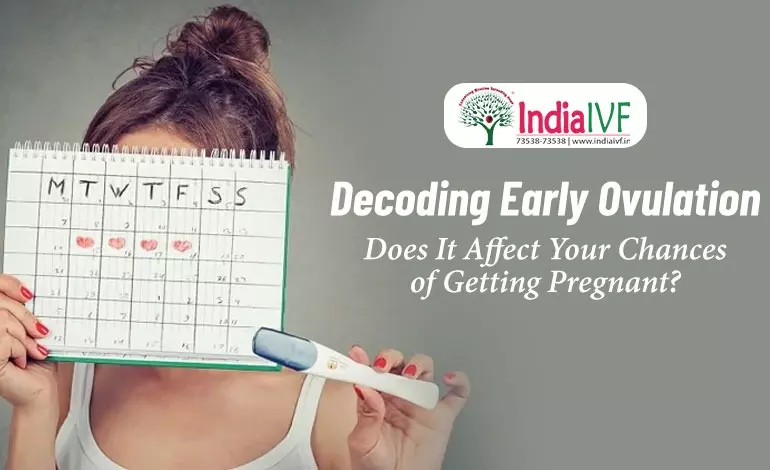
Early ovulation occurs when your ovary releases an egg much sooner than Day 14—often as early as Day 8, Day 9, or Day 10 of your cycle. Because the egg is released so early, your “fertile window” shifts to a time when you might not even expect it, such as right after your period ends.
The Relationship between Early Ovulation and Pregnancy
Navigating fertility can often feel like deciphering a complex code. With early ovulation, this feeling might get exacerbated. Does early ovulation really make it harder to get pregnant?
To answer this question, let’s break down the components of your menstrual cycle and its relationship to your fertility journey.
Menstrual Cycle and Fertility
To dive deeper into early ovulation, let’s break down the three main phases of your cycle:
- The Follicular Phase: This starts on the first day of your period. This is when your body produces Follicle Stimulating Hormone (FSH) to grow eggs. In early ovulation, this phase is shorter than usual.
- The Ovulation Phase: The mature egg is released.
- The Luteal Phase: This happens after ovulation. The body produces progesterone to thicken the uterine lining.
In cases of early ovulation, the Follicular Phase is cut short, while the Luteal Phase usually stays the same length. This results in a shorter total cycle (e.g., a 21-day or 24-day cycle).
Common Causes of Early Ovulation
Why does the body decide to release an egg so soon? Several factors can trigger early ovulation:
- Age and Diminishing Ovarian Reserve: As women get closer to perimenopause, the brain sends stronger signals (higher FSH) to the ovaries to produce an egg, which often leads to early ovulation.
- Stress: High levels of cortisol can disrupt the communication between the brain and the ovaries.
- Smoking and Alcohol: These toxins can speed up the aging of follicles.
- Hormonal Imbalances: Conditions like hyperthyroidism or elevated FSH levels can lead to a shorter follicular phase.
- Lifestyle Changes: Significant weight loss, gain, or intense exercise can shift the timing of your cycle.
But, Here’s the Catch!
While early ovulation may not directly impact your fertility, it can certainly affect your ability to plan intercourse around your ‘fertile window’ – the small window of time when the egg is viable for fertilization. If you’re tracking ovulation based on the ‘average’ day (day 14), early ovulation can mean that you miss this critical window, making it harder to get pregnant.
The Risk and Utility of Knowing Your Ovulation Timing
Utility of Understanding Early Ovulation:
The primary utility of tracking early ovulation is accuracy in conception. If you are tracking based on a “standard” calendar, you will miss your fertile window entirely. By identifying early ovulation, you can adjust your intercourse schedule or clinical treatments to match your body’s unique rhythm. It also helps doctors diagnose if you have a “short follicular phase,” which might require hormonal support.
Risks Associated with Early Ovulation:
The main risk is egg immaturity. If the egg is released too early (before Day 8 or 9), it may not have had enough time to mature fully. An immature egg has a lower chance of being fertilized or may lead to early pregnancy loss. Additionally, if the egg is released very early, the uterine lining (endometrium) might not be thick enough yet to support implantation.
Does Early Ovulation Make it Harder to Get Pregnant?
This is the question every woman asks. The answer is: Not necessarily, but it requires better planning.
If your early ovulation results in a healthy, mature egg and you have intercourse at the right time, you can absolutely get pregnant. However, it becomes “harder” because:
- The fertile window is missed.
- The egg might be slightly immature.
- The uterine lining might not be ready.
At India IVF Fertility, we specialize in helping women overcome these timing challenges through precision monitoring.
How India IVF Fertility Helps You Manage Early Ovulation
If you are struggling with early ovulation, our experts use a variety of tools to help:
- Follicular Monitoring: We use high-resolution ultrasounds to watch the egg grow and predict exactly when it will be released.
- Hormone Testing: We check FSH, LH, and Estrogen levels to see why your body is ovulating early.
- Medication: Sometimes, we use medications to “steady” the cycle and ensure the egg reaches full maturity before release.
- Lifestyle Counseling: Small changes in diet and stress management can often reset a cycle that is trending toward early ovulation.
Conclusion
The road to parenthood can sometimes be fraught with unexpected hurdles and detours, but understanding how your body works is the first step in navigating these challenges. While early ovulation can make it harder to accurately identify your fertile window, it doesn’t inherently impact your fertility. With the right guidance and support from fertility experts like those at India IVF Fertility, you can navigate this journey with confidence and optimism.