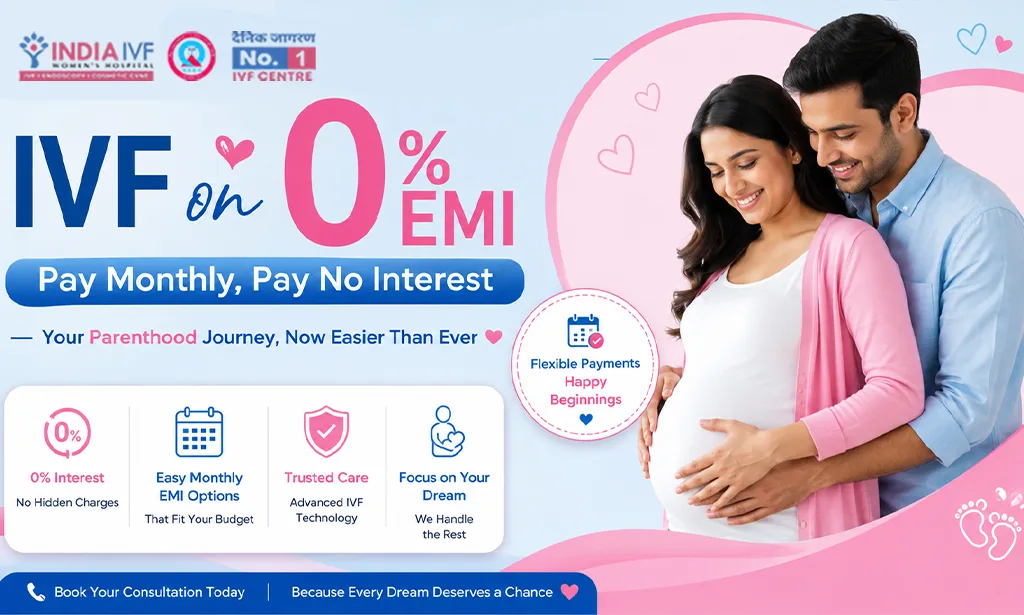
Let’s start with the sentence you came here for: yes, you can pay for your IVF treatment in monthly instalments at 0% interest.
At India IVF Fertility Clinic, we partner with leading medical-finance institutions to break your IVF treatment cost into 6 to 24 easy monthly instalments — with no interest added. A ₹1,50,000 amount becomes ₹12,500 a month over a year, or ₹6,250 a month over two years. Approval is paperless and usually done within 24 hours. You can start treatment as soon as it’s approved.
But here’s where we’re going to be different from every other clinic page you’ve read today.
If you’ve already googled “is no-cost EMI really free?”, you’ve probably stumbled onto a wall of articles warning you it’s a trap — hidden interest, surprise GST, inflated prices. And you’re right to be cautious. So instead of just flashing “0% EMI!” at you and hoping you don’t ask questions, we’re going to show you exactly how a genuine zero-interest plan works, hand you a simple checklist to test any clinic’s claim (including ours), and explain why your written, itemised quote is the only number that matters.
Because the truth is, money should never be the reason you delay treatment. Age, unlike a bill, can’t be renegotiated later. Let’s make the financial part simple.
Key Takeaways (the 60-second version)
- You can split your IVF cost into 6–24 monthly instalments at 0% interest at India IVF — you pay exactly your quoted amount, not a rupee more.
- “No-cost EMI” isn’t always genuinely free elsewhere. On credit-card EMIs especially, banks can quietly charge 18% GST on a hidden interest component. Always ask for the total repayment figure in writing.
- A genuine medical EMI works through “subvention” — the clinic absorbs the bank’s financing cost, so your monthly instalments add up to your quoted amount.
- Approval is fast and paperless: PAN, Aadhaar and 3 months’ bank statement, usually cleared in 24 hours, no collateral.
- The real hidden cost in IVF is medicines, not interest — they can add ₹30,000–₹1,20,000 and are left out of most “packages.” Our quotes are itemised, so what you see is what you finance.
- Most health insurance still won’t cover IVF in India in 2026, though a few newer policies and corporate plans are starting to. EMI fills the gap for most couples.
- It’s still a loan. A soft eligibility check won’t dent your credit score, but the EMI itself is reported to credit bureaus, so paying on time matters.
Your EMI, calculated — find your amount, pick your tenure
Once your specialist gives you a written, itemised quote, the monthly maths is simple: there’s no interest baked in, so we just divide your amount by the number of months. Find the figure closest to your quote in the table below.
| Treatment amount | 6 months | 12 months | 18 months | 24 months |
| ₹75,000 | ₹12,500/mo | ₹6,250/mo | ₹4,167/mo | ₹3,125/mo |
| ₹1,00,000 | ₹16,667/mo | ₹8,333/mo | ₹5,556/mo | ₹4,167/mo |
| ₹1,25,000 | ₹20,833/mo | ₹10,417/mo | ₹6,944/mo | ₹5,208/mo |
| ₹1,50,000 | ₹25,000/mo | ₹12,500/mo | ₹8,333/mo | ₹6,250/mo |
| ₹1,75,000 | ₹29,167/mo | ₹14,583/mo | ₹9,722/mo | ₹7,292/mo |
| ₹2,00,000 | ₹33,333/mo | ₹16,667/mo | ₹11,111/mo | ₹8,333/mo |
| ₹2,50,000 | ₹41,667/mo | ₹20,833/mo | ₹13,889/mo | ₹10,417/mo |
| ₹3,00,000 | ₹50,000/mo | ₹25,000/mo | ₹16,667/mo | ₹12,500/mo |
The formula is simply: monthly EMI = treatment amount ÷ number of months. Because it’s a true 0% plan, that’s the whole calculation — no interest, no markup. These amounts are illustrative; your exact figure always comes from your written quote.
[Editorial note: confirm available tenure options and partner names with the finance team before publishing. Availability of specific tenures is subject to the finance partner, treatment type and eligibility.]
Notice what these numbers do to the decision. A ₹1.5 lakh amount paid upfront is a savings decision — the kind that makes couples wait months they can’t spare. Spread over 24 months, the very same amount becomes a ₹6,250 monthly-budget decision. That’s roughly what many families spend on a weekend out. Same care, completely different feeling.
“Is no-cost EMI actually free?” — the honest answer most clinics won’t give you
This is the question keeping you up, so let’s settle it properly.
You’ve probably read that “zero-cost EMI” is a myth. Here’s the nuance that those scare-articles flatten: it depends entirely on the type of EMI.
Credit-card “no-cost EMI” — be careful here. When you convert a purchase to a no-cost EMI on a credit card, the bank still calculates interest internally and then “discounts” it. The catch: tax rules treat that interest as a financial service, so 18% GST can be charged on the interest component — and you pay it, even though the plan is sold as interest-free. There can also be a processing fee, and the full amount may get blocked against your credit limit. The Reserve Bank of India itself noted years ago that a true “zero percent” interest scheme doesn’t really exist in that retail context — the cost is often just camouflaged.
A genuine medical EMI through a finance partner — this is the real 0%. Here, the lender (an NBFC or bank) funds your treatment, and the clinic absorbs the financing cost through what’s called a subvention or merchant-discount arrangement. Because it’s structured as a loan, the principal and interest aren’t subject to GST the way credit-card interest is. So your monthly instalments genuinely add up to your quoted amount — no more.
That’s the kind of plan we offer. You pay your written, itemised quote, divided across your chosen months. Full stop.
Your 4-question checklist — use it on us, and on any clinic
Don’t take anyone’s word — including ours. Before you sign any EMI agreement, ask these four questions and get the answers in writing:
-
“Is the quoted amount the same whether I pay upfront or on EMI?” If the “EMI price” is higher, that gap is the interest. A genuine 0% plan never inflates the price.
-
“Is there a processing fee or any GST on it — and how much?” A clean medical-EMI may have little or none; a credit-card route often does. You want the number, not a shrug.
-
“Is a down payment required, and how much?” Many partners need zero or minimal down payment. Know before you plan.
-
“What is my total repayment over the full tenure?” Add every instalment plus any fees. If that total equals your quoted amount, it’s truly 0%. If it’s even 3–5% higher, it isn’t.
A clinic that answers all four clearly and in writing is one you can trust with something far bigger than money. That’s the standard we hold ourselves to.
How approval works — 3 steps, about 24 hours
We’ve made this deliberately boring, which is exactly what you want from a finance process.
-
Step 1 — Tell your counsellor at consultation. You’ll get your itemised quote and a digital application link. No forms to chase.
-
Step 2 — Upload three documents from your phone. PAN, Aadhaar, and your last 3 months’ bank statement. No branch visits. No collateral.
-
Step 3 — Get approved, usually same or next day. The finance partner pays the clinic directly, and your first instalment starts the following month. Treatment can begin the moment approval comes through — you don’t lose a single cycle waiting.
Who is eligible for IVF EMI?
The bar is friendlier than most people expect.
You’ll generally qualify if you’re salaried or self-employed with a regular income, aged roughly 21 to 60, with basic KYC documents in order. A co-applicant — your spouse or a parent — can strengthen the application and sometimes unlock a higher limit or longer tenure. And you don’t need a perfect credit score; a modest score is usually enough.
Here’s a detail couples appreciate: our financial care coordinator can run a soft pre-eligibility check that doesn’t affect your credit score. Only when you formally proceed does it become a recorded loan application. So you can find out where you stand with zero risk to your CIBIL.
EMI vs. personal loan vs. credit-card EMI — which is actually cheapest?
People often confuse these three, and the difference can cost tens of thousands. Here’s the plain-language version.
A genuine 0% medical EMI (through the clinic’s finance partner) is usually the cheapest, because the clinic absorbs the financing cost. Your total repayment equals your quoted amount. This is the route we set up for our patients.
A personal medical loan (from a bank or NBFC) is a true loan with real interest — typically in the region of 12–18% per year — plus a processing fee. Useful if you need a large amount or a very long tenure, but you will pay more than the treatment costs. Worth it only when a 0% option isn’t available for your full amount.
A credit-card EMI is the most convenient and often the most expensive once GST-on-interest, processing fees and lost cashback are counted. It also blocks your credit limit. Fine in a pinch; rarely the smartest choice for a six-figure medical bill.
The rule of thumb: start with the genuine 0% medical EMI, top up with a personal loan only if needed, and treat credit-card EMI as a last resort.
Does insurance cover IVF in India? (The question behind the question)
Many couples reach for EMI only after discovering their insurance won’t help. So let’s be clear-eyed about it.
In 2026, most standard health-insurance policies in India still do not cover IVF. A few newer policies and fertility riders have begun offering partial coverage — but usually only after a waiting period of two to three years, and often capped per cycle, frequently excluding medicines. Some progressive corporate employers (especially in tech, finance and MNCs) now include limited IVF benefits, so it’s genuinely worth asking your HR. Government employees may have partial CGHS coverage in some states; ESI does not currently cover private-sector IVF.
The honest takeaway: check your policy and your employer benefits first — but for the large majority of Indian couples right now, a 0% EMI is the practical way to make treatment affordable today rather than waiting years for a rider to mature. And waiting, as you know, is the one thing fertility doesn’t forgive.
The real hidden cost of IVF isn’t interest — it’s medicines
Here’s an industry secret that does more financial damage than any EMI ever could.
When clinics advertise an IVF “package,” that price often covers the core procedure — consultation, monitoring scans, egg retrieval, lab fertilisation, embryo transfer — but leaves out the stimulation medicines. And those injections, taken daily for one to two weeks, are frequently the single biggest line item, adding anywhere from ₹30,000 to ₹1,20,000 depending on your body’s response and whether Indian or imported brands are used. Couples with low ovarian reserve often need higher doses, pushing it to the top of that range.
Other components that quietly appear on the final bill at many centres: ICSI (₹30,000–₹50,000), embryo freezing and yearly storage, and PGT-A genetic testing (₹50,000–₹1,50,000). Stack these up and a “₹1.5 lakh package” can become a much larger surprise mid-cycle.
This is exactly why we lead with an itemised, written quote. What’s planned is listed, what’s listed is financed, and what’s financed is what you pay. Because the EMI is built on your full written quote, your monthly number doesn’t lurch upward halfway through treatment. No mid-cycle shocks — emotionally or financially.
Why India IVF offers 0% EMI
We’re India’s first PHYGITAL fertility chain, with centres across Delhi, Gurugram, Noida, Ghaziabad, Srinagar and Gwalior and more. And we built our payment model around one belief: a couple should never have to choose between their savings and their timeline.
IVF costs vary by city — metros typically run a little higher than tier-2 towns, mostly because of rent and overheads, not because the science is any better. Wherever you’re treated with us, the EMI option turns a daunting lump sum into a manageable monthly figure, while your written quote protects you from hidden additions. The financing is there so your energy can go where it belongs: on the treatment, not the invoice.
A word from Dr. Richika Sahay Shukla
“In my clinic, I’ve watched couples postpone treatment for a year to ‘save up’ — and that lost year is sometimes the most expensive decision they ever make, because ovarian reserve doesn’t wait. A transparent EMI changes that maths entirely. My only rule is honesty: the patient should always know the exact number, in writing, before anything begins. Care and clarity aren’t opposites — they’re the same promise.”
— Dr. Richika Sahay Shukla, Chief Consultant & Director, India IVF Fertility (trained at AIIMS and Sir Ganga Ram Hospital)
Trust & Transparency
This article is general information to help you plan, not personalised financial or medical advice. Exact EMI tenures, eligibility, fees and partner terms depend on the finance institution, your treatment plan and your profile, and are confirmed in your loan agreement and Key Facts Statement. India IVF Fertility follows a transparent, itemised-pricing approach and does not influence clinical recommendations based on payment method — your treatment plan is decided purely on medical need. Where the broader “no-cost EMI” market has grey areas (GST, fees, credit-card traps), we’ve explained them honestly so you can make a confident choice.
Turn a scary lump sum into a monthly number that fits your life
You don’t have to choose between your dream and your bank balance. Come in for one free visit, bring your reports, and leave with two things: an honest, itemised treatment plan and a monthly EMI figure that works for your budget.
📞 Call +91-7353873538 or WhatsApp us to get your treatment quote and EMI eligibility — checked without touching your credit score. 🌐 Book at our Delhi, Gurugram, Noida, Ghaziabad, Srinagar or Gwalior centres via www.indiaivf.in.
Your family plan shouldn’t wait for payday. Let’s make it monthly.
Reviewed for accuracy by
India IVF Fertility — Financial Care team, in consultation with Dr. Richika Sahay Shukla, Chief Consultant & Director (AIIMS and Sir Ganga Ram Hospital trained).
References & Authoritative Sources
-
Reserve Bank of India — guidance on zero-percent interest / no-cost EMI schemes (RBI circular, transparency in lending). https://www.rbi.org.in
-
ClearTax — GST on No Cost EMI: Rates, Applicability and Credit Card Impact. https://cleartax.in/s/gst-on-no-cost-emi
-
Business Today — Is No Cost EMI really free? Pros, cons & hidden costs. https://www.businesstoday.in/personal-finance/banking/story/is-no-cost-emi-really-free-when-should-you-opt-for-it-pros-cons-hidden-costs-467006-2025-03-06
-
Indian Council of Medical Research (ICMR) — Assisted Reproductive Technology (Regulation) Act, 2021. https://main.icmr.nic.in
-
Insurance Regulatory and Development Authority of India (IRDAI) — health insurance and fertility coverage guidance. https://www.irdai.gov.in
-
World Health Organization (WHO) — Infertility fact sheet. https://www.who.int/news-room/fact-sheets/detail/infertility