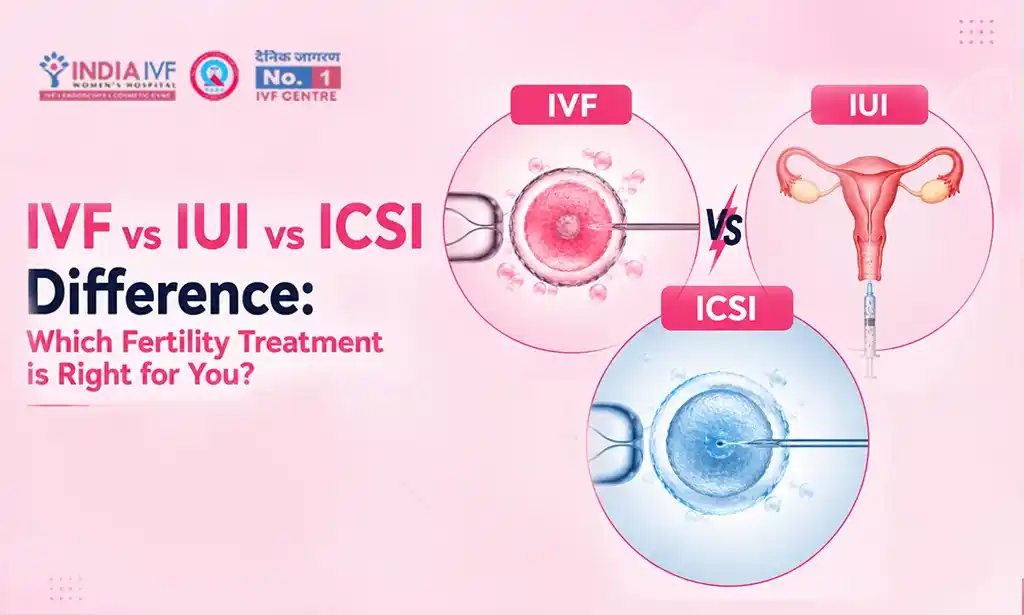
When navigating the journey to parenthood, medical terminology can often feel overwhelming. If you are exploring assisted reproductive technologies, you have likely come across three common terms: IUI, IVF, and ICSI Differences While they all aim to help couples achieve pregnancy, they differ significantly in their approach, complexity, and success rates.
In this guide, we break down the IVF vs IUI vs ICSI difference to help you understand which path might be right for your specific situation.
What is IUI (Intrauterine Insemination)?
IUI is often referred to as “artificial insemination.” It is the least invasive fertility treatment.
- The Process: During ovulation, a concentrated sample of healthy sperm is collected, washed, and directly injected into the woman’s uterus using a thin catheter. This bypasses the cervix and places the sperm closer to the egg.
- Best For: Couples with mild male infertility, unexplained infertility, or those using donor sperm.
What is IVF (In Vitro Fertilization)?
IVF is a more comprehensive procedure where fertilization occurs outside the body.
- The Process: The woman undergoes hormonal stimulation to produce multiple eggs. These eggs are retrieved and combined with sperm in a laboratory dish. Once fertilization occurs and an embryo develops, it is transferred into the uterus.
- Best For: Blocked fallopian tubes, severe endometriosis, or failed IUI cycles.
What is ICSI (Intracytoplasmic Sperm Injection)?
ICSI is a specialized form of IVF.
- The Process: Unlike standard IVF, where sperm is left to fertilize the egg naturally in a dish, in ICSI, a single, high-quality sperm is carefully selected and injected directly into the center of each mature egg using a microscopic needle.
- Best For: Severe male factor infertility (low sperm count, poor motility, or abnormal morphology).
IVF vs IUI vs ICSI Difference Explained
The fundamental difference lies in where the fertilization happens. In IUI, fertilization occurs naturally inside the woman’s body after the sperm is placed in the uterus. In IVF, fertilization takes place in a controlled laboratory environment where eggs and sperm are combined in a dish. ICSI is a more precise lab procedure where a single, healthy sperm is manually injected directly into the center of a mature egg.
In terms of complexity and cost, IUI is the least invasive and most budget-friendly. IVF involves a moderate level of complexity and cost, while ICSI is the most complex and expensive due to the high-level laboratory equipment and embryologist expertise required.
Comparison Table: IUI vs IVF vs ICSI
|
Feature |
IUI |
IVF |
ICSI |
|
Fertilization |
Inside the body |
Lab (Dish) |
Lab (Manual injection) |
|
Complexity |
Low |
Moderate |
High |
|
Success Rate |
10-20% |
40-50% |
High (Male factor) |
|
Cost |
Budget-friendly |
Moderate |
Most expensive |
Which One Should You Choose?
The choice depends on your specific fertility diagnosis:
- Choose IUI if you are just starting and have mild fertility issues.
- Choose IVF if you have been trying for a long time or have structural issues like blocked tubes.
- Choose ICSI if the male partner has significant sperm-related challenges that make natural fertilization in a lab dish unlikely.
Conclusion: Making the Right Choice for Your Future
Choosing between IUI, IVF, and ICSI is a deeply personal decision that should be made in consultation with a fertility specialist. While IUI offers a less invasive, cost-effective first step for many, IVF and ICSI provide more advanced, precise solutions for complex fertility challenges.
The most important factor is not necessarily the “most popular” procedure, but the one tailored to your specific reproductive health needs. Whether it is addressing male factor infertility through ICSI or overcoming structural barriers with IVF, modern reproductive technology has opened numerous doors for couples worldwide.